Friday, March 20, 2020

My Preparedness Adventure


  As a member of the Church of Jesus Christ of Latter-day Saints, I grew up in a home where the prophet’s counsel to have a year’s supply of food storage was taken seriously. Every modern prophet since Brigham Young has warned members to prepare for hard times. Hard times can include natural disasters, famine, civil unrest, and pandemic. Having been through several hurricanes, tornadoes, ice storms, and now living in an earthquake zone, the first one was easy to understand, but it took 9-11 and the Coronavirus pandemic for me to really appreciate the wisdom in being prepared.

  I remember helping my mother bottle produce when we lived in Provo, Utah. My dad was attending Brigham Young University on the GI bill. We were far from family in Maryland, and thankfully far from a grandmother who had nothing but scorn for storing food. Many people thought like she did, that as long as there are grocery stores nearby, you’d be fine. How many people know that grocery stores have a mere two-days’ worth of stock, or that community water towers can only provide enough drinking water for a single day? The assumption is that if something “really bad” were to happen, the government would take care of us. When my son Davis did a research paper on FEMA’s response to Katrina, I discovered how very wrong that assumption was. FEMA couldn’t take care of one city, New Orleans. I don’t want to imagine that level of incompetence on a national scale.  

  I remember sitting at the kitchen table for hours (or what seemed like hours to a four-year old), pitting cherries one at a time for Mom to bottle. I recall picking apricots at someone’s farm. I also remember falling in the creek, getting fished out and spanked by my dad (because he told me not to go near the creek), and spending the afternoon dripping wet, wrapped in a blanket, while my parents and older brother Adam finished picking apricots.

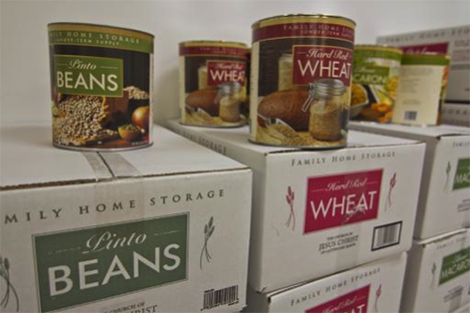
  My parents had wheat, powdered milk, sugar, oats, and other staples, which they purchased from the bishop’s storehouse (now called Home Storage Centers) when we lived in Utah. I remember them hauling the cases of #10 cans from house to house with each move, and also Mom’s struggle to figure out where to store them. I discovered black widow spiders on boxes when she stored them in a shed, and felt her frustration with my dad when he pulled out the floorboards and stored the cases under a staircase, where she had no way to get to them. When I was about seven-years old, my parents agreed to be Perma Pak representatives in exchange for a good deal on a year’s supply of a new invention: freeze-dried foods.

  Except for the cans of bacon bits that my brothers and I snacked on, we never ate the Perma Pak. I think for my parents, it was disaster insurance -- long-term storage. It was shifted from house to house with each move (and we moved a lot). My mom tried to give me a few rusty cans of Perma Pak shortly after I got married, but I said, “No thanks.” When I was a child, she would occasionally make bread from the wheat storage and something she called scones from bread dough, although I now know it was Navajo fry bread. I vividly remember the chalky taste of powdered milk, even if it was mixed half and half with regular milk.

  The bottled produce, however, was always delicious, and my mom canned every summer, although it was an incredible amount of work. She would put up dozens of quarts of pickles, slaving away in a kitchen with no air conditioning. I remember skinning peaches as they were transferred from the boiling water to the ice water. Although I helped her more than I wanted to, Mom never taught me the process of bottling produce, and I remain in ignorance to this day. I still love bottled peaches, and I miss my mom’s pickles, even if they did stink up the house.

  My own venture into food storage has been quite different from my parents’ struggles. My husband Glen and I had nothing extra on hand until we moved into our first house and a friend gave us a few buckets of wheat from her parents’ downsizing efforts. We borrowed a grain mill and attempted to make bread with some of it. It was good, but the learning curve was steep, even though I’d helped my mother bake bread many times. Like bottled produce, she never really taught me the process of turning wheat into edible bread.

  As a twenty-something, I still thought ‘food storage’ meant wheat, so we bought 400 pounds of it when our ward (local LDS congregation) had an emergency preparedness coordinator to help with such things. When Hurricane Fran knocked out our power for several days in 1996, I had a wake-up call and realized we needed to have much more stored to feed our four small boys. After being snowed in for two weeks in 2000, I started to get serious about preparedness.

  When we moved to Silver Spring, Maryland, in 2001, we discovered two resources: Costco and a Home Storage Center in nearby Upper Marlboro. We started buying food in bulk from Costco, filling our new basement (hooray) with canned goods. Back then members were still allowed to work at the church canneries, and our ward would organize groups to drive to the Upper Marlboro facility. We canned turkey chunks, beef chunks, spaghetti sauce, and berry jam. It was a lot of work, but many hands made the task manageable, and we took home cases of food we helped can. Glen and I were able to put the 400 pounds of wheat into #10 cans, and began adding many more things to our storage, including the dreaded powdered milk.

  When we moved back to North Carolina in 2005, where few houses have basements, we searched for a house with a room suitable to store our fledgling supply. We found a place with two master walk-in closets, and used the smaller one for food storage. We put in a large garden, but being rookies at bottling produce, the tomatoes got the better of us. We put up a dozen jars, but the rest went bad before we could get to them. This was before we knew it was okay to freeze tomatoes. The learning curve is still steep, especially when you don’t have older relatives around to help.

  The house after that had no extra closets, so we got creative. There was a large niche wall in the bonus room. We put in a long curtain rod across the front of the niche, invested in shelving units to line the wall behind the curtains, and filled the shelves with food. We took another stab at bottling with a bushel of peaches from the farmers market. Even with all five kids helping, it was a sticky mess that took all day. I honestly don’t know how my mother did it. Glen grew different types of peppers the next summer and bottled dozens of pints of pepper relish by himself. I realize now that I don’t have the patience for bottling.

  The next house in 2010 had a basement with a wine cellar that was the perfect space for storing food -- since we didn’t need it for wine. By this point the church leaders were pleading with members, who ignored the counsel to have a year’s supply, to store at least a three months’ supply of food. Short-term storage became popular. I filled the wine cellar with things I could buy in cases from Costco: tomato sauce, green beans, corn, peaches (not as good as bottled), soups, etc. For the first time I felt confident that our family could survive whatever crisis hit next.

  When I was called to be the ward’s emergency preparedness coordinator, the church had stopped allowing members to work in the canneries, due to new FDA guidelines. Now all we had to do was call in an order and go pick up the already-canned foods. The closest Home Storage Center was in Greensboro -- 1.5 hours away -- so gathering an order for ward members was hard work. Fortunately we owned a Suburban, so it was manageable. I took advantage of my new calling and our ample basement to stock up.

  At the same time, I began to wonder what we would eat after consuming our short-term, three months’ supply of ‘normal’ canned goods -- vegetables, fruits, tuna, and things from the grocery store and Costco -- and had to use our long-term supplies in the #10 cans. Oatmeal, homemade bread, powdered milk, and beans and rice didn’t sound like something I’d want to eat every day, although it would keep the family alive. Since Glen and I hadn’t made another serious attempt to bottle any produce, it seemed as though our diets would suffer during a long-term crisis. Although we had blueberry bushes and an apple tree, our gardening attempts have never been stellar because we plant things but hate to weed.

  A friend from a different ward introduced me to another resource: freeze-dried foods from a company called Emergency Essentials. EE had group specials every month, which were foods you could get a great deal on if you ordered more than twelve cans. They had me at ‘free shipping.’ I began coordinating orders for my ward. For two years, I probably spent $100 or more on EE every month, stockpiling #10 cans of freeze-dried fruits, vegetables, meats, cheeses, peanut powder, and baking ingredients like powdered eggs and butter, but when Augason Farms bought them out a few years ago and the prices went way up, I was glad I invested when I did. I also filled five gallon jugs for water storage and stocked up on paper goods and first aid supplies. We turned the shed into a chicken coop and enjoyed fresh eggs every day. We had a wood stove in the house and plenty of firewood. I felt truly prepared for any emergency for the first time in my life.

  When my son’s family moved into an apartment, just before we moved away from North Carolina in 2017, I set aside some of everything from our food storage for them. It was a good feeling to leave them prepared. Now that the church’s Home Storage Center has online ordering, I can send them things anytime, at least until they’re done with college and can afford to buy their own.

  My food storage experience has come full circle as my family returned to the place my parents started prepping in 1970 -- Utah. We live less than two miles from a Home Storage Center. There are entire rooms in the basements of most homes set aside just for food storage. We have a potato bin and can buy fifty-pound bags of monster-size spuds for $11, since we live so close to Idaho. It’s normal here for people to have gardens, mature fruit trees, and to regularly bottle produce and fill their freezers with fresh corn on the cob. Even living in a ‘prepper friendly’ area, I was shocked to discover that many people don’t use their storage. Like my parents, they invest in a year’s supply, but rarely touch it. In twenty years, they throw it out and start over. Such a waste, in my opinion. In a crisis, your family will become ill if they have to live off what you’ve stored. Whole wheat doesn’t agree with digestive systems accustomed to store-bought bread, for example. Children won’t touch powdered milk -- although it tastes much better than what the church used to manufacture.

  “Store what you eat, eat what you store,” is my mantra. I use what we store and replace it regularly. When the Coronavirus crisis hit in March, 2020, and people panicked to buy what they needed to be quarantined for weeks, I was at peace. And no, the preppers didn’t create the great TP shortage, it’s the unprepared that cleared out the stores. My family was prepared to be quarantined at home for weeks or even months. I hope people will not become complacent again after Coronavirus is a distant memory, but who knows. Denial isn’t just a river in Egypt. No, the government isn’t going to take care of you, neither is your crazy prepper (and well-armed) neighbor. It’s a Grasshopper and the Ants analogy -- plan ahead and prepare for hard times. It’s that simple. I've been working at it for over thirty years. 

  One thing I hope people realize after Coronavirus is that having advanced notice to buy what you need is a luxury. Electricity, running water, internet, and trucks to restock grocery shelves are great blessings. The next crisis might give us zero time to prepare. Could you live on what you have in your house for more than a few days? Something to think about. And may I say this would be a great year to put in a garden?

  “If ye are prepared, ye shall not fear.” ~Doctrine and Covenants 38:30
Image result for Mason jars bottled produce

Image result for LDS church food storage cans

Sunday, September 29, 2019

SPARKLES


  I come from a long line of cynics. On my mother’s side with low thyroid issues, we tend to be complainers. The glass is always half empty so we’re never satisfied that there’s enough to drink. On my father’s side with anger issues, we tend to be critical. The half empty glass isn’t clean enough to drink out of so we’re bitter that we’re still thirsty. Consequently, I’ve struggled most of my adult life with a gray outlook, like a dark sky with an occasional patch of blue. It took me years to figure out that persistently looking at life with the glass half empty was actually depression. I’ve struggled to see the positive things in my life, even when they were abundant. If things were going well for a time, I tried to savor the moment because I assumed it wouldn’t last. If it sounds like a dreary way to view life, it is! I’m a living (bad) example of how your attitude determines your altitude.
  I’ve been fortunate that no matter where I’ve lived, I’ve had a friend or two with a bubbly, positive personality. For them, the glass is always half full and the sky is always blue with only an occasional gray cloud. You know the type of person I mean because you’ve probably met a few in your life. If you’re really blessed, you were able to marry or parent someone who sparkles. They’re friendly, positive, and fun to be around. I’ve always wanted to be that kind of person, but since modern medicine hasn’t devised a personality transplant, I’m just grateful I’ve been able to associate with a few sparkly people. Their happiness is contagious, like a rising tide that lifts all the boats.
  I want to mention of few of these special souls, as a way of thanking them for their influence on my life. A friend who sparkles is worth hanging onto, so thank you, Paula Wiggins Jones, Christy Martschenko, Patti Maxwell, Torie Sue Jacobson, and Debbie Stahmann. There have been other good friends, but these five stand out to me as wonderful examples of the power of positive thinking. They are grateful for everyone and everything in their lives, and count every problem as a blessing in disguise. Skies always seem to be blue and cloudless when I spend time with them.
  I would be remiss if I didn’t mention one man I was grateful to know who sparkled: Derek Davis. He was so positive that anyone who met him came away feeling uplifted. The little town I lived in has a 5K race every summer to honor his memory.
  I once heard Church of Jesus Christ of Latter-day Saints President, Thomas S. Monson, speak at a BYU Women’s Conference. Something he said really stayed with me: Be sure your list of regrets is short. Sure, we all make bad decisions sometimes or lose our cool and have to apologize later, but regrets tend to shackle our progress if we view them as liabilities instead of lessons. Being negative is one of my biggest regrets. Negativity often distorted my view of opportunities and experiences. However, whenever I’ve shared anything on my regrets list with one of my sparkly friends, they’ve helped me to see my stumbling blocks as stepping stones. Here’s one example:
  In 2003, my husband and I adopted a ten year old boy from Thailand. At the time, we had five other children, ages twelve to three. We were completely blindsided by the challenges this boy brought to our family. We struggled for a year to parent him, but for the safety and well-being of the other five, we made the painful decision to disrupt the adoption. Another family who had more experience with our son’s overwhelming special needs offered to adopt him. We learned later that this troubled young man had RAD -- reactive attachment disorder. Any attempt to parent him, except by those with special training, would have been a disaster, as it was for us. I don’t mention his name at the request of his adoptive family.  
  During the dark year with our son, one person remained a ray of light for me: Torie Sue Jacobson. She buoyed me up when I felt weighed down. I don’t exaggerate when I say she kept me from losing my sanity that year. I had nothing to offer her except a litany of endless complaints, but she radiated positive energy, helping me focus on the things going well in my life, no matter how small. Torie’s family moved away the day before our son went to live with his new family. I felt like God sent her at this specific time because He knew I needed a sparkly friend.
  Yes, there’s a spiritual message woven into my ramblings: God knows each of us, individually. He knows our strengths and weaknesses, and often answers our prayers for help by allowing us to find someone to lighten our load. In my case, those answers have come in the form of friends who sparkle. Aside from naturally exuberant personalities on the outside, one thing they also have which makes them shine from within: a personal relationship with Jesus Christ. They all have powerful testimonies of the Savior and follow His example in everything they say and do. I aspire to be a little bit like them by being grateful for my blessings and trying to focus on the positive things in my life. With my gray-sky outlook, it’s hard! I try to appreciate the little things, whether it’s a son who does the dishes without asking or a student at work who compliments me on my shoes, I’m learning to savor the little moments.
  My father (yes, the critic I mentioned earlier), who passed away thirteen years ago, often told me the best way to forget my own troubles was to serve someone else. He was a good example to me because he often stopped to help friends and strangers alike, even if it wasn’t convenient, or he was running late, or he didn’t have a dime in his pocket to assist them, he always made the effort. I need to do this more. I often feel bogged down in the day-to-day chores no one seems to notice at home. I try to look at what I do as serving my family. If I get a thank you or a hug once in a while, I try to feel grateful someone noticed.  
  While I know I’ll never manage to have a sparkly personality, I can attempt to shine a little bit, and maybe lift someone else. Jesus Christ was the perfect example of service, and when we serve others, somehow the sky seems a little bluer. The water in that half-empty glass tastes a little sweeter. I’m grateful for Him, and for the sparkly friends in my life who glow because they know and love Him. I appreciate their examples, and that they’ve been there for me when I needed a light to see my way.
Image result for blue sky with clouds
    

Wednesday, April 3, 2019

TAKE THAT TRIP -- IT'S WORTH IT


  I love to travel, and I’ve been fortunate to grow up in a family of wanderers, and marry into

a family that makes traveling a priority. While it’s a drag to sit for hours in airports, live out of a
suitcase, and deal with the stomach distress of strange foods, traveling is worth the expense and hassles. Flat tires, canceled flights, lost luggage, and seedy hotels are all part of the adventure. Seeing new places and experiencing new cultures is one of my favorite things to do.


  When I was very young my father was in the Army. I don’t remember much about living in Yorkshire, England, but I’m grateful my parents took the opportunity to see parts of Europe. I was also able to see different parts of the country living in Maryland, Utah, Michigan, North Carolina (east, west, and central), and the Blue Ridge Mountains of Virginia. 

  As an adult, I’ve been able to travel with my husband for work to Honolulu, San Diego, Amsterdam, Beijing, and Orlando. We traveled internationally for adoptions to Hefei and Guangdong, China, and Bangkok, Thailand. When my brother’s family was stationed in Ramstein, Germany, we took the family to Europe to see London, Paris, Amsterdam, Brussels, Trier, and we took a Rhine cruise. We’ve also been blessed to have family living in interesting places like Charleston, New Orleans (before Katrina), and Boston. 

  We lived outside of Washington, D.C., for four years, giving us access to incredible museums and national history. As a child and as an adult, I’ve been able to visit many church historical sites (Church of Jesus Christ of Latter-day Saints), resulting in some unforgettable trips to Palmyra, NY, Salt Lake City, UT, and Nauvoo, IL. Living most of my life in North Carolina, I’ve been to the beaches and mountains too many times to count.

  Now that we live in Utah, we’ve been to Yellowstone and the Grand Tetons. This month we’ll visit Arches and Zion National Parks when my mother-in-law comes to visit. Her travel résumé is twice as long as mine. At the young age of 83, she still plans trips all over the world. 

  Our bucket list for travel includes an Alaskan cruise, Scotland and Ireland, Italy, Switzerland, New Zealand, and Hawaii again, maybe with all of our adult children this time. Planning a trip gives you something to look forward to, a break from the mundane and the constant grind of work and life in general. I honestly don’t know how people can never travel outside their home states. There is so much to see, and it doesn’t cost a fortune if you plan ahead. 

 
What I’ve learned from a lifetime of travel:
1)    Don’t wait. Don’t put it off. If you have an opportunity to travel somewhere, go.
2)    Take the kids, no matter how young. Yes, it’s makes traveling more complicated, but being away from your young children can really put a damper on your enjoyment. And if they’re old enough to remember the trip, it will become a priceless memory for all of you.
3)    Venture outside your comfort zone. Some of the most breathtaking sites are well beyond the ‘tourist’ areas. In Beijing, we skipped the touristy section of the Great Wall and went to Mutianyu one weekend and Simitai the next. It was so worth the long drives and arduous climbs see unrestored, original parts of the Great Wall.
4)    Take your time. My husband Glen wants to see as much as possible and often makes long ‘to-do’ lists when we arrive someplace. Cut the list in half and take the time to appreciate what you can see. If you’re with children, cut the list in half again. To me, listening to Glen complain about what we might miss is a small price to pay for avoiding exhaustion. In London, the rest of the family went on strike after walking for miles along the Thames. We were tired and hungry but Glen wanted to keep walking, so we sat down on a bench and refused to go any further unless the next thing we saw was the nearest Tube station and the stop for our hostel.
5)    Don’t drink the water. This is true no matter where you travel. Yes, London tap water is safe, but don’t drink it. It’s not the same as the water in NC. Learned from painful experience, plus I missed a full day of sight-seeing in London.
6)    Be aware of your surroundings. If you travel abroad, be safe. Wear a money belt, don’t keep your wallet in your back pocket (or keep all your money in it -- use the hotel safe), tell the taxi-driver to set the meter (and be prepared to exit the cab if he won’t), say no to stranger’s offers to ‘give you a personal tour’ or ‘take a ride in my boat’ -- really, there are too many types of swindles to name them all. Keep your kids close, even in areas that seem family-friendly. Don’t be afraid to haggle over prices, especially in Asia, and don’t be afraid to walk away if you feel that they’re trying to take advantage of you because you’re a ‘rich American.’
7)    Learn a little bit of the language, just a few phrases like ‘where is the toilet?’ or ‘how much does it cost?’ can save you a lot of pantomiming and potential headaches.
8)    Respect the culture. It’s important not to offend the natives. Learn enough about their ways so you don’t lose your temper or make them lose theirs in certain situations.
9)    Take memorable pictures -- put yourself in them. Yes, the Eiffel Tower lit up at night is amazing (and worth the hour-long sweltering subway ride), but a photo of your family standing in front of it will mean more to you years from now.
10)  Keep a travel journal because someday you will forget what a wonderful time you had.   

Monday, November 12, 2018

The Overdue Blog Post: It's About Time (No, it really is about TIME)


  Image result for clocks and watches


  Life is crazy and I’ve been trying to think of a blog topic for weeks. Between substitute teaching, my church calling, and endless family drama (ask me about the tenant we evicted from our NC house -- no, on second thought, don’t ask), my writing has been on the back burner for months. I. Hate. It. I’ve been sewing quilts to feel like I’m accomplishing something. The only problem is that every time I go to the fabric store, I think of new quilts I want to sew, and the writing gets more neglected. Yesterday I sat down to read over the few chapters of Vesta Divided I wrote somewhere back in September, and drew a total blank on what I planned to write next. Even with the book’s detailed outline on a piece of paper next to my laptop. Help, someone kidnapped my muse, and I think the villain is Time.
  I’m convinced we are our own worst enemies when it comes to beating ourselves up over how we use our time. For example, the time I spend on Facebook since I signed up for it could have been used to write six novels by now. Instead I waste time online, arguing with strangers over Constitutional rights and posting photos of the quilts I’ve sewn. I know it’s a black hole for my time, but why do I spend hours on it?
  Why is time so easy to waste? When I’m at work, I want to be writing. When I’m doing housework, I want to be writing. When I’m reading or editing someone else’s work, I want to be writing. When I’m writing I want to be actually writing instead of moving commas around and changing my indent spacing.
  As a creature of habit, I have a few requirements that need to be in place for the writing muse to visit. You might call them excuses (you can omit ‘might’), but I’m not one of those authors who can write anywhere and keeps a daily word count goals. (NaNoWriMo? Get thee hence!) I must be at my desk, in front of a window, room temperature ideal, and no distractions. Which means if my family is at home, I’m not going to get much done.
  To be fair, I’ve trained my family not to talk to me when I’m at my desk. If the matter is urgent (like the house is on fire), they can interrupt after I look up from whatever I’m typing. For years my husband couldn’t understand why I got irritated by what he considered reasonable interruptions – “What’s for dinner?” “Who cares? Go away.” “Do we need to pick up (name of son) from work?” “By ‘we’ do you mean ‘me’? Go away.” – Until I painstakingly explained to him that stopping in the middle of a thought or sentence was maddening. “Can it wait? Then go away!”
  I consider writing the highlight of my life, so why isn’t the bulk of my time focused on it? Am I so distracted that I can’t rescue my poor muse and keep her safe in the land of no distractions? Don’t I want to finish my book? (Yes!) So what’s the problem?
  There’s a season for everything (cue music, “Turn, Turn, Turn” by the Byrds) and since I’m not in school (as a student), don’t have small children at home, don’t work full time, and am not in the middle of renovating my house (yet), I should have tons of time to write, right? How I envy authors who manage to crank out 5,000 words a day with small children, a full-time job, and a house renovation in progress! I should be the master of time, not its servant, so what to do?
  Getting off the internet would be a start. Keeping my phone in my purse where I can’t hear it beep when I get a text. Stop reading – that’s like saying “stop breathing” – but books are a distraction for me. Stop loading new ebooks onto my Kindle (staying offline would help with that issue). Delegating chores like meal preparation and laundry to my fully-capable adult sons would make life easier. The job I can’t cut back on, or the calling, and I can’t ditch my family (although sometimes I’d like to), but I can figure out where my time management goes off the rails and fill that void with writing.
  Guilt is never good motivation to get things done. If all we did was give, give, give, we would be hating life in short order. Yes, there are things we, as functioning adults, are obligated to do every day. But “take time to smell the roses” is important too. So some days I waste an hour or two reading, cooking something decadent (and eating it), painting my toenails, texting or having lunch with a friend, or staring out the window at the falling snow, but these selfish moments help recharge me for the next round of duties.
  As we get into the Christmas season, doesn’t it feel as if we have even less time to work with? Suddenly the calendar fills up and stress levels rise. I evaluated how I spend my time in December years ago and came to the conclusion that I would be happier if I gave up baking. Less cleaning the kitchen. Less weight gain. And since I’m off gluten, there’s no temptation lying around to be consumed. It’s a win-win because I feel less busy, less stretched. Christmas is about Christ, right? Not cookies.  
  So I’m done rambling – I think. My goal is to stop wasting time where I can and get back to writing. What will you do with your time? Is it your servant or your master?